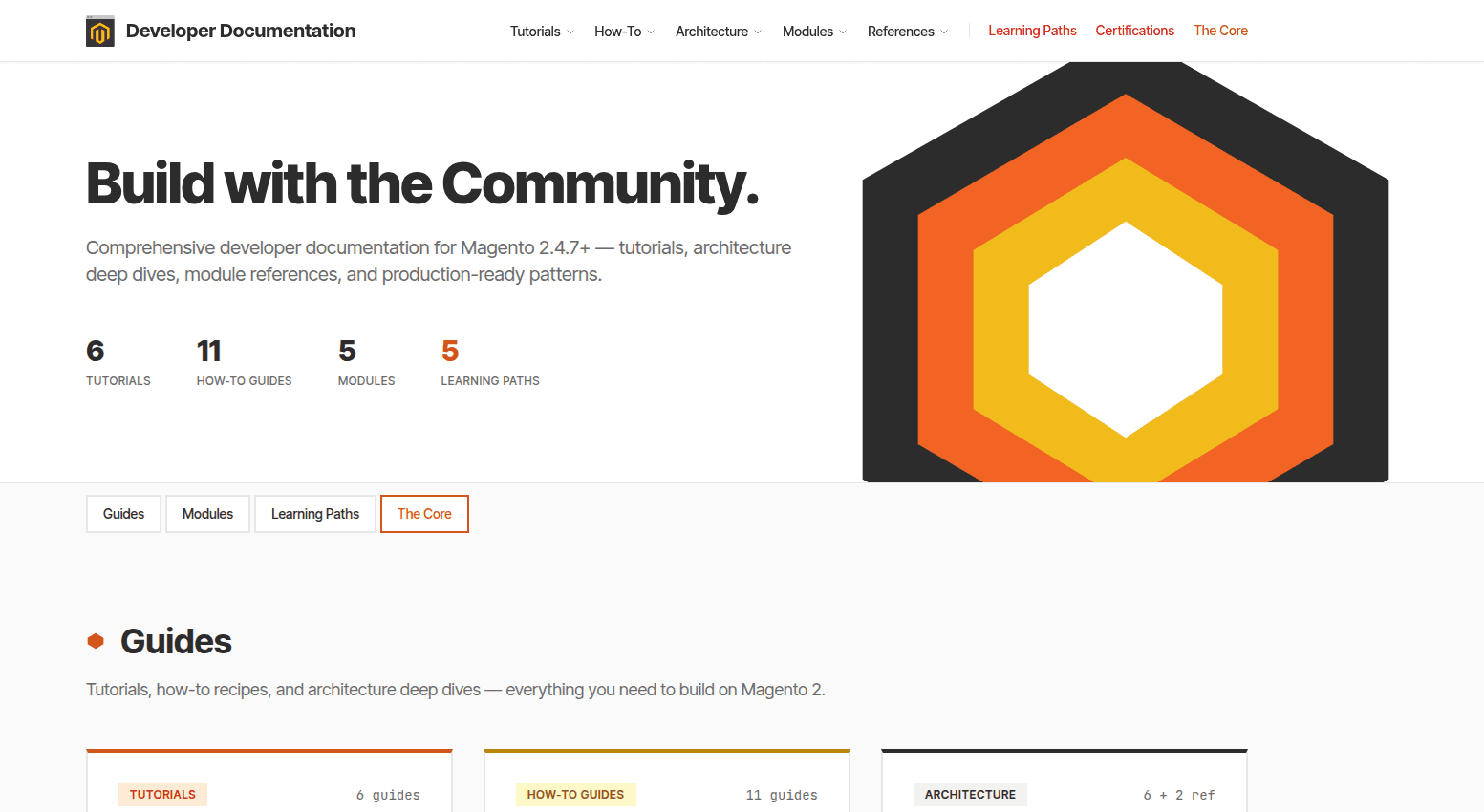
The official Magento developer documentation has been a known pain point in the ecosystem for years. After Adobe shifted focus towards Commerce Cloud, the open-source devdocs stagnated — outdated examples, missing coverage for newer APIs, and entire subsystems left undocumented. We've taken over the Magento Association developer documentation project and we're actively rebuilding it.
The Problem
If you've tried to learn Magento development recently, you'll know the documentation gap. The official Adobe docs cover Commerce Cloud features well, but the foundational developer material — how plugins actually execute, how to structure a module properly, how the checkout flow works under the hood — is either incomplete, outdated, or spread across Stack Overflow threads and blog posts from 2018.
The Magento Association recognised this and initiated a project to rebuild the developer documentation from scratch. That's where we came in.
What We're Building
This isn't a wiki or a collection of README files. We're building a comprehensive, structured documentation platform covering Magento 2.4.7+ with tutorials, how-to guides, architecture deep dives, module references, and curated learning paths.
Developer Guides — 25 and Growing
We've structured the guides around the Divio documentation framework — separating tutorials (learning-oriented), how-to guides (task-oriented), explanations (understanding-oriented), and references (information-oriented). Each guide type serves a different purpose and a different moment in a developer's workflow.
The current guide set covers:
6 step-by-step tutorials — Docker development setup, declarative schema and data patches, plugin system deep dive, custom payment methods, custom shipping methods, and product type development
11 how-to guides — full page cache strategy, layout XML deep dive, cron jobs, admin UI components, CI/CD pipelines, ERP integration patterns, multi-store configuration, testing strategies, security checklists, email templates, and import/export
6 architecture explanations — EAV system architecture, GraphQL resolver patterns, indexer system deep dive, message queue architecture, service contracts vs repositories, and B2B features development
2 reference documents — CLI command reference and upgrade guide for 2.4.6 to 2.4.7/2.4.8
Every guide includes structured metadata — difficulty level, estimated completion time, prerequisites, and version compatibility. A developer can look at any guide and immediately know whether it's relevant to their current task and skill level.
Module Documentation — 5 Core Modules, 9 Documents Each
We've created a standardised documentation template for Magento's core modules. Each module gets nine dedicated documents covering architecture, execution flows, plugins and observers, integrations, anti-patterns, known issues, version compatibility, and performance considerations.
The five modules currently documented are Catalog, Checkout, Sales, Customer, and Quote — the backbone of any Magento store. That's 47 individual reference documents, each generated from actual source code analysis of Magento 2.4.7.
Learning Paths
Raw documentation isn't enough. We've built five curated learning paths that guide developers through the material in a logical sequence:
Getting Started — for developers new to Magento (~5 hours)
Catalog Mastery — advanced product and category development
Checkout and Payments — the full purchase flow from cart to order
Performance and Scalability — caching, indexing, and optimisation at scale
Enterprise and B2B — multi-store, B2B features, and advanced commerce patterns
The Core — 67 Auto-Generated References
We built a source code parser that analyses the Magento 2.4.7 codebase directly — reading di.xml configurations, events.xml, module.xml, and PHP source files. It generates 67 reference documents covering 10 core modules, giving developers a reliable, machine-verified view of how the framework actually works rather than how someone remembers it working.
Certification Study Guides
The site includes seven dedicated certification pages aligned with Adobe's exam objectives — covering Developer Expert, Frontend Expert, Architect Master, and more. Each maps directly to the documentation, so developers studying for certification can use the same material they use on the job.
How We Built It
Building 93+ documentation pages by hand would take months. We built an AI-assisted generation pipeline using the Mastra agent framework — a two-track system that generates developer guides and module references in parallel, with human review at every stage.
Track A: Developer Guides
The guide pipeline uses retrieval-augmented generation (RAG) with a Qdrant vector store. We feed it the Magento source code, existing documentation fragments, and our Handlebars-based templates. Each guide goes through an eight-criteria quality rubric before publication — accuracy, completeness, code quality, version specificity, practical value, structure, readability, and cross-referencing.
Track B: Module References
The module pipeline parses Magento's XML configuration and PHP source directly. It maps dependency graphs between modules, identifies plugin chains and observer registrations, and generates structured documentation from the actual codebase. No guesswork, no assumptions — the documentation reflects what the code does.
The Documentation Site
The site itself is built on a Laravel backend with Vite, Tailwind CSS, and Alpine.js on the frontend. It includes DocSearch for full-text search, auto-generated tables of contents, Mermaid diagrams for architecture visualisation, and responsive design that works properly on mobile — something the old devdocs never managed.
We've built it to WCAG AA accessibility standards with proper colour contrast, keyboard navigation, and semantic HTML throughout. Every page has been through a Playwright test suite for cross-browser validation.
What's Next
Phase 6 of the delivery plan scales the project to 50+ developer guides and 100 module references. We're working through the backlog now — expanding coverage into areas like MSI (Multi-Source Inventory), Page Builder, Staging and Preview, and the full REST and GraphQL API surface.
The documentation is a living project. As Magento evolves — 2.4.8 shipped recently — the content updates alongside it. The source code parsers mean we can regenerate module references against any new release.
Why This Matters
Good documentation makes the entire ecosystem stronger. Developers onboard faster. Fewer hours get burned reverse-engineering framework behaviour. Junior developers have a real learning path instead of piecing together outdated blog posts. And the platform itself benefits — better-informed developers write better modules, build more stable stores, and contribute more effectively to the open-source project.
We're engineers who build Magento stores every day. Writing this documentation isn't academic — it comes directly from production experience. When we document the checkout flow, it's because we've built and customised it across multiple live stores. When we write about plugin execution order, it's because we've debugged the edge cases in real client code.
The Magento developer documentation deserved better. We're building it.